
M I S S I O N
The Mission of the Florida Black Historical Research Project Inc. is to research, collect, and disseminate knowledge of significant contributions Blacks have made in the State of Florida.

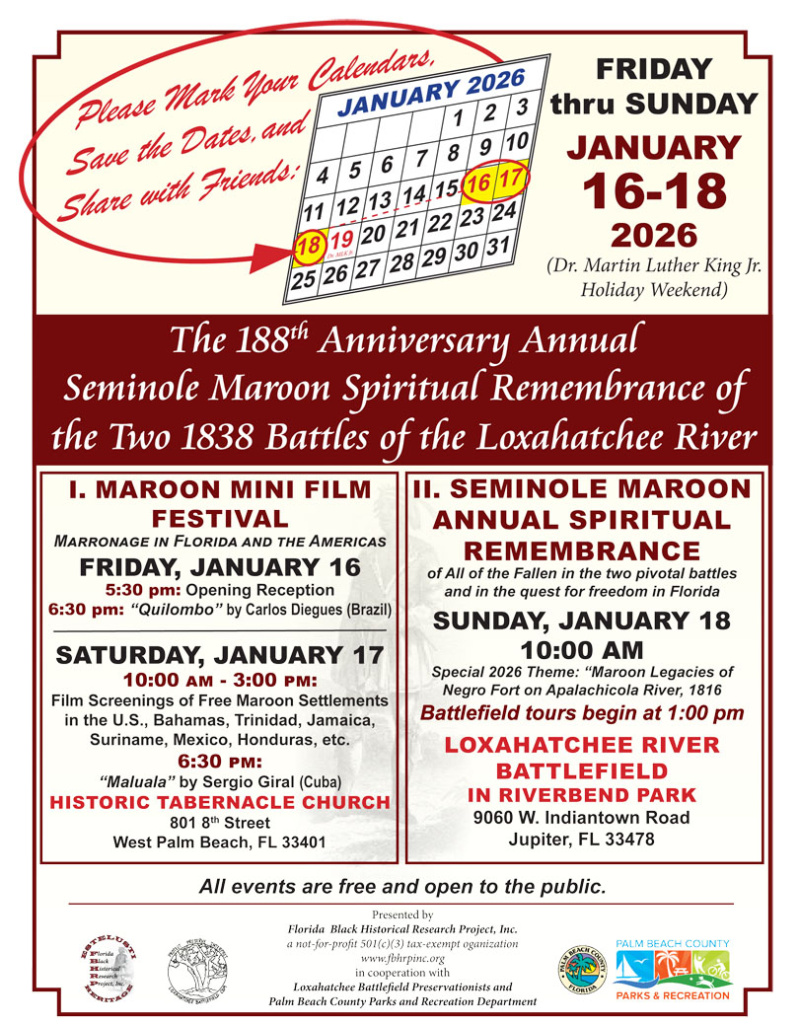
Florida Black Historical Research Project, Inc. (FBHRP) invites
you to Palm Beach County, January 16-18, 2026
to commemorate the 188th Anniversary
of the Second Seminole War at Loxahatchee River Battlefield.
We will explore its connections to hemispheric marronage
in the context of America 250!
"Marronage in the Americas" is our theme as we seek to
honor Seminole Maroons who found freedom in Florida
before, during and after the signing of the Declaration of Independence,
the founding moment of the United States.
We’re hosting this 3-day celebration of maroon history,
and we’d love to see you there!
Join us for "Marronage in the Americas,"
beginning Friday, January 16, 2026 at 5:30 PM at
Historic Tabernacle Church at 801 8th Street,
West Palm Beach, FL 33401.
Activities continue on Saturday, January 17,
at 10:00 am at Historic Tabernacle Church
and Sunday, January 18, at 10:00 am
at Loxahatchee River Battlefield Park in Jupiter, FL.
REGISTER soon because space is limited.
We hope you’re able to join us!
Hotel reservations
FYI for our visitors from out-of-town:
We have confirmed limited availability at
The Fairfield Inn by Marriott on Indiantown Rd. in Jupiter, FL.
Please call 561-748-5252. Ask for Beverly or Ashley.
We look forward to seeing you in Palm Beach County
January 16-18, 2026.
DAY CLEAN IN LA FLORIDA
A Poem By Wallis Tinnie
(With highest regard and gratitude,
an allusion to Langston Hughes’s “Daybreak in Alabama”)
When I become an Artist
I’ll draw me some pictures
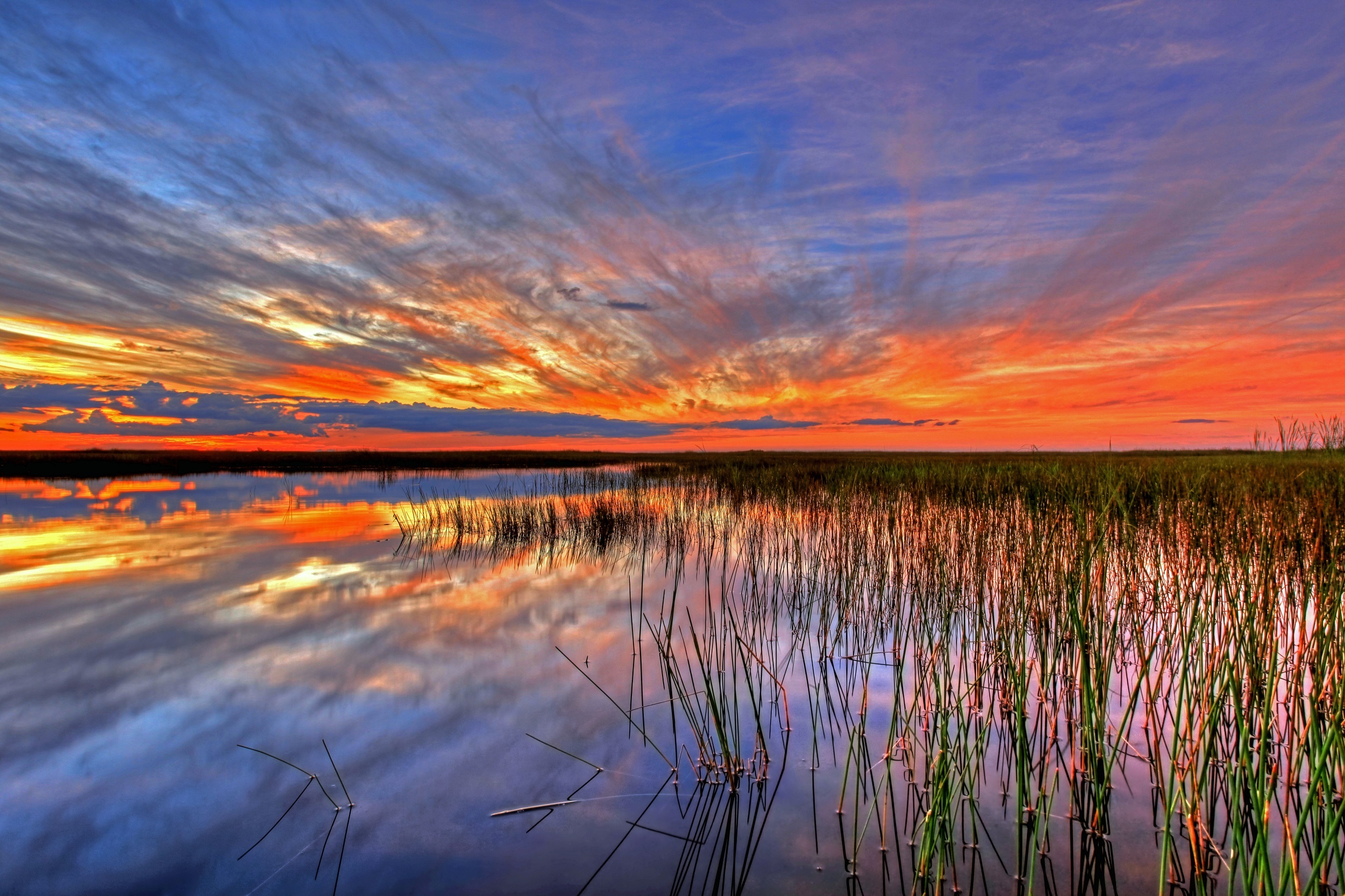
About day clean in La Florida
I’ll put some glorious paint in it
There’ll be the silence of grey moss
disguised by the morning dew
ghosts glittering on mighty oaks
And the fertile promise of ebony muck
in Belle Glade and Pahokee Near Lake Okeechobee
The air will be redolent with the sweet memory
Of Seminole Maroon camp fires
And softened by the aroma of pine needles
and Tallahassee clay after rain.
And there will be “black and white black white”
and red and black red “black people”
And I’ll paint “white hands and black hands”
and black and red hands “and brown and yellow hands”
And black muck hands
And shell mound hands
“Touching everybody with kind fingers
And touching each other natural as dew”
In that dawn of color
when I Become an artist
And paint about daybreak
In La Florida.
Did You Know?
• Africans were in the Americas centuries before Columbus and the “slave trade,” as shown by the research of scholars like Ivan van Sertima and Leo Weiner. Some evidence suggests an early African presence in Florida.
• Africans accompanied the first Spanish explorers and settlers of Florida, nearly a full century before the English settlement of Jamestown, Virginia.
• While the Southern colonies, and later Southern states of the U.S., were dominated by plantation slavery, Florida was Spanish territory and “Freedom Land” for Africans escaping enslavement and Native peoples escaping settler encroachment on their traditional lands.
• Pirates were known for exercising “complete integration and complete democracy.” Among the most legendary of pirates was Black Caesar, who operated in South Florida waters.
• The first invasion of a foreign country by the U.S. began with the incursions into Florida which became known as the Seminole wars.
• Both the words “Seminoles” and “Maroons” are derived from the Spanish word “cimarrones,” which was used for livestock which escaped into the wild. “Cimarrones” became “Siminoli” in the Creek Indian language, and then “Seminole” in English.
• “The Seminoles were a people, not a tribe,” consisting of numerous Native groups and Africans. Black Seminoles were especially valuable to the alliance as interpreters, since they knew both European and Native languages.
• The Seminole Wars were the costliest in U.S. history, in both money and bloodshed, until the Vietnam War.
• The main goal of the Seminole Wars was not only to “fight Indians” and to displace them west of the Mississippi River on the Trail of Tears, but equally importantly to "recapture the 'property' " of Southern slave owners and prevent further escapes of enslaved people.
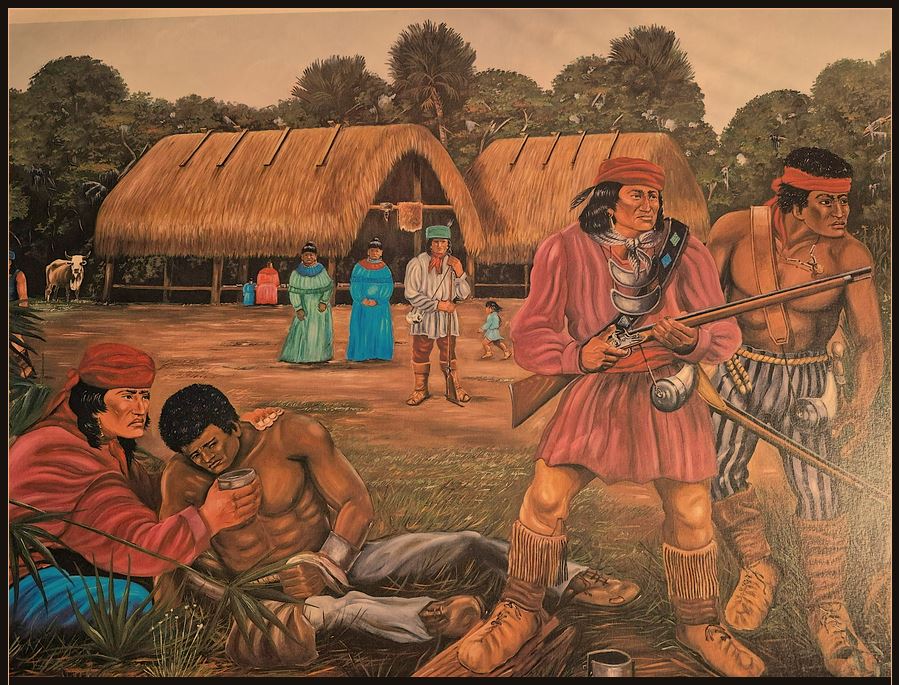
• One of the most important sites of the Second Seminole War was the 1838 Loxahatchee River Battlefield in northern Palm Beach County, Florida, where Black and Native Seminoles, outnumbered and outgunned, fought bravely for their freedom, until they were captured by U.S. forces, dishonorably, under a flag of truce, and marched on the Trail of Tears to Tampa, shipped to Louisiana and east Texas, and marched to Oklahoma.
Dear Lovers of History and Culture:
This comes to request your support of Florida Black Historical Research Project, Inc.'s [ FBHRP ] new initiative, "Speaking Memory, Archives, and Artifacts."
This project was selected for promotion in a fundraising effort to support Black Non-profit organizations, Give 8/28, organized by Mighty Cause.
Financial Contributions--small, very small, tiny, really miniscule! none and large, very large, gigantic!--are appreciated .
Important also is your sharing this message with someone who you feel would support this effort.
We appreciate your support, your presence at our events, your financial contributions and your publicity. Every gesture is important. All support is welcome and valued.
On behalf of the Board of FBHRP, I thank you.
Sincerely,
Wallis Tinnie
Board Member
Florida Black Historical Research Project, Inc
REGISTRATION No. CH28088
A copy of the official registration and financial information may be obtained from the division of consumer services by calling toll-free 1-800-HELP-FLA (435-7352) or visit online at www.FloridaConsumerHelp.com. Registration does not imply endorsement, approval, or recommendation by the state.
Website Photo Header Credit: Original photography and montage by Stephen Marc, depicting an Annual Spiritual Remembrance of the Loxahatchee Battlefield in Jupiter, Florida, a turning point in the "Seminole Wars." Prominently shown are the late Isa Hamm Bryant, founder of the FBHRP (in Seminole shirt), and Carib Tribal Queen Mrs. Catherine Hummingbird Ramirez, who has regularly performed the Opening Blessing and Prayer on these occasions.

